The Map of Money's Fine Print: Why a Loan That's Illegal in One State Is Perfectly Legal Next Door
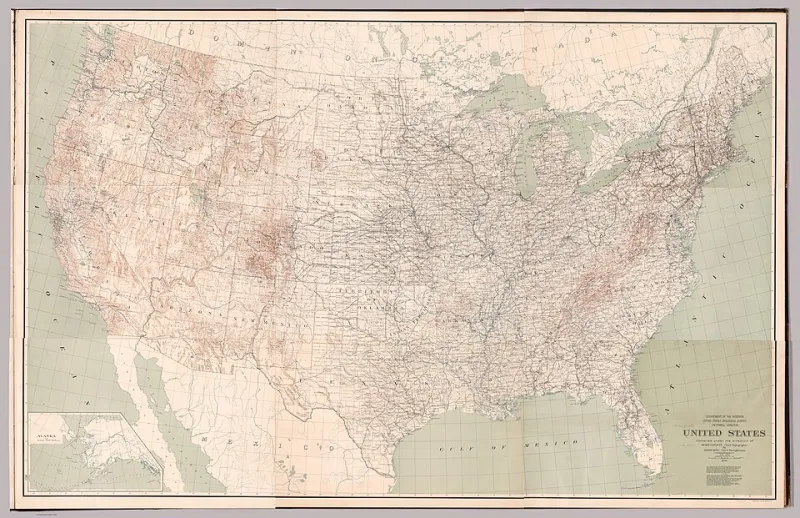
Photo: John Wesley Powell / Henry Gannett, Public domain, via Wikimedia Commons
A borrower in Colorado who takes out a $500 installment loan faces a hard legal ceiling on what the lender can charge. Drive across the border into neighboring states on the same day, with the same credit profile and the same loan request, and the price can multiply several times over. Nothing about the borrower changed. Only the map did.
This is the quiet geography of American lending. Unlike most developed economies, where consumer credit pricing is governed nationally, the United States delegates the core question — how expensive can a loan be? — to fifty state legislatures, plus the District of Columbia. The result is a patchwork so uneven that the legality of a triple-digit interest rate depends less on arithmetic than on a ZIP code.
The 36% Line in the Sand
The number that anchors most of this debate is 36% APR. It is not arbitrary. The figure traces back nearly a century, to the 1941 report of the Russell Sage Foundation's model lending law, and it resurfaced in 2006 when Congress capped payday-style loans at 36% APR for military service members and their families through the Military Lending Act. Lawmakers on both sides of the aisle concluded that rates above that threshold tended to trap borrowers in cycles of re-borrowing rather than bridge genuine shortfalls.
Today, roughly twenty states plus the District of Columbia enforce APR caps at or near 36% for typical small-dollar loans, effectively shutting out traditional payday lending. States including Colorado, Montana, New Hampshire, and South Dakota have adopted this standard, many through ballot initiatives passed over the objections of the lending industry. On the other end of the spectrum, a cluster of states — Texas, Nevada, Mississippi, and others — impose no meaningful cap at all, allowing lenders to charge what the market will bear. In practice, that has meant annualized rates of 400%, 600%, even 1,000% on short-term products.
How Triple Digits Survive Where Caps Exist
A state cap, however, is only as strong as the loopholes around it. Lenders facing unfavorable rules have developed several workarounds that borrowers should understand.
Fee engineering. Because many caps apply to interest but not to separate charges, lenders restructure pricing as origination fees, monthly maintenance fees, credit insurance premiums, or "access" charges. A loan advertised at 29% interest can carry an all-in cost well above 200% once these add-ons are annualized.
Tribal lending arrangements. Some online lenders partner with Native American tribes, asserting that tribal sovereign immunity exempts them from state usury laws. Courts have partially pushed back — the theory has failed in several litigations — but the structure persists, and borrowers often do not discover the arrangement until they are already in the contract.
Rent-a-bank schemes. Federally chartered banks are generally exempt from state interest rate caps. Some fintech lenders originate loans through partner banks in cap-free jurisdictions, then immediately sell the loans back to the fintech. Federal regulators have scrutinized this practice, and the FDIC has moved to limit it, but variations continue.
Product reclassification. Auto title loans, certain open-end credit lines, and storefront installment products are often governed by different statutes than payday loans, letting lenders migrate to whichever category carries the loosest rules in a given state.
What the Strongest States Do Differently
The states with the most robust borrower protections tend to share three features. First, they cap the all-in cost, not just the stated rate, closing the fee-engineering channel. Second, they set minimum loan terms — often 90 days or longer — so that payments are spread out and the per-payment burden drops. Third, they enforce caps through licensing regimes, meaning unlicensed online lenders operating in the state are vulnerable to enforcement and their contracts may be void or unenforceable.
Colorado's 2018 reform is frequently cited as a model: it preserved access to small-dollar credit while capping costs at 36% plus a monthly maintenance fee, and lenders remained profitable under the structure. The lesson many consumer advocates draw is that affordability and access are not mutually exclusive.
Checking Your Own Exposure
Borrowers can take several concrete steps to understand where they stand:
- Look up your state's usury laws. State banking regulators publish the applicable caps for small-dollar, installment, and payday products. A search of your state's "[State] payday lending laws" through the official regulator's site is a reliable starting point.
- Calculate the true APR, not the advertised rate. Federal Truth in Lending disclosures must show the APR on most loans, but fee-heavy products sometimes obscure it. Online APR calculators can convert fees and payment schedules into a comparable figure.
- Verify the lender's license. Most states require lenders to be licensed to lend to residents. If an online lender cannot produce a license for your state, the contract may not be enforceable — a fact worth knowing before you sign, not after.
- Watch for choice-of-law clauses. Some contracts specify that disputes will be governed by the law of a lender-friendly state. Whether such clauses hold up varies, but they signal that the lender is structuring around your state's protections.
The Road Ahead
Congress has repeatedly considered extending the 36% standard nationwide, most recently through proposals modeled on the Military Lending Act, but no comprehensive federal cap has passed. For now, the map is what it is: a borrower's protection depends on where they happen to live and whether their state legislature — or ballot initiative process — has drawn the line.
Until that changes, the most powerful tool available to most borrowers is information. Knowing whether your state caps rates, how lenders might route around those caps, and what the true annualized cost of any offer is can mean the difference between a manageable loan and a long, expensive trap.