Same Score, Different Rate: The Hidden Variables That Separate Borrowers With Identical Credit Numbers
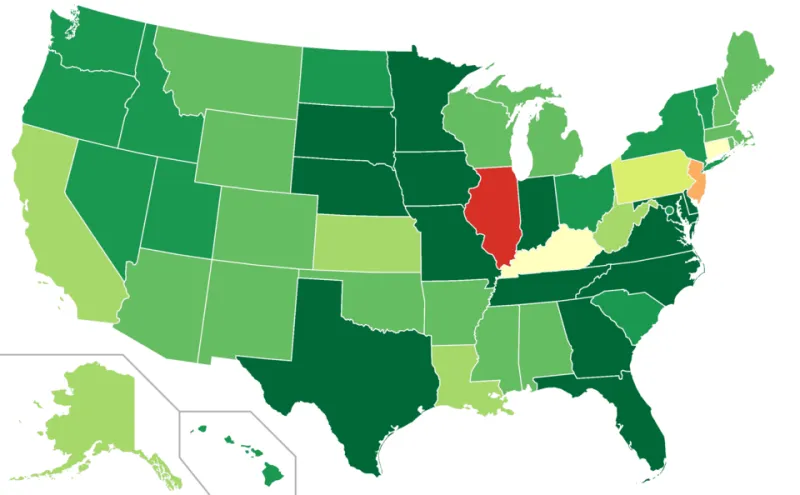
Photo: Szmenderowiecki, CC BY-SA 4.0, via Wikimedia Commons
Two borrowers sit across from the same loan officer at the same institution on the same afternoon. Both carry a 750 FICO score — a number widely regarded as the threshold for favorable lending terms. One walks away with a 6.8% interest rate on a personal loan. The other is quoted 9.4%. Neither fully understands why.
This scenario plays out tens of thousands of times each week across the United States, and it exposes a fundamental misunderstanding that many Americans hold about how borrowing actually works. The credit score is not the verdict. It is the opening argument.
Why the FICO Score Is Only the Beginning
The Fair Isaac Corporation's scoring model was designed to measure creditworthiness in a standardized, accessible way. It does that reasonably well. But it was never intended to be the sole instrument lenders use to price risk — and in modern lending, it rarely is.
Major banks, credit unions, and online lenders increasingly rely on proprietary scoring models that layer additional data points on top of the standard FICO calculation. These internal models may weigh your existing relationship with the institution, the composition of your credit portfolio, your geographic location, and even behavioral patterns extracted from your transaction history. Two borrowers with identical FICO scores can present very different risk profiles when viewed through these more granular lenses.
According to research from the Consumer Financial Protection Bureau, the range of interest rates offered to borrowers within the same credit score band can vary by several percentage points, depending on the lender and the loan type. That spread is not random. It reflects deliberate risk-pricing decisions driven by data the borrower never sees.
The Behavioral Signals Lenders Actually Watch
Beyond the headline number, lenders are quietly evaluating a constellation of behavioral signals that speak to how you manage money in practice — not just how you appear on paper.
Payment timing patterns are one such signal. Paying your bills on or slightly before the due date reads differently to some lenders than consistently paying on the final day of the grace period. While both behaviors technically qualify as on-time payments under FICO's methodology, proprietary models may interpret the latter as an indicator of cash flow strain.
Credit utilization trends tell a more nuanced story than a single snapshot. A borrower whose utilization has declined steadily from 40% to 12% over eighteen months may be viewed more favorably than someone whose utilization has hovered at 12% but spiked to 38% twice in the same period — even if both borrowers report the same utilization rate on their most recent statement. Lenders with access to trended credit data can observe the trajectory, not just the current position.
Income stability signals have grown increasingly important, particularly among fintech lenders who access bank account data through open banking integrations. Consistent direct deposit amounts arriving on predictable schedules suggest employment stability. Irregular deposit patterns — even with a high average income — can introduce uncertainty into a lender's model.
Debt-to-income ratio remains one of the most consequential underwriting factors that the FICO score does not directly capture. Two borrowers with identical scores may carry dramatically different monthly debt obligations relative to their income, and this figure will substantially influence both approval odds and rate offers.
Alternative Data and the New Frontier of Lending
The expansion of alternative data in lending decisions has accelerated considerably over the past decade. Some lenders now incorporate rental payment history, utility bill consistency, and even subscription payment patterns into their models. While this creates opportunities for borrowers with thin credit files to demonstrate reliability through non-traditional means, it also means that the variables influencing your rate are increasingly difficult to anticipate.
For borrowers with established credit histories, the implication is that maintaining a strong FICO score is necessary but not sufficient. The borrowers who consistently secure the most favorable rates tend to present clean, stable profiles across every dimension a lender might examine — not just the dimensions that feed into the standard score.
What Borrowers Can Actually Control
Given the opacity of proprietary lending models, it is reasonable to ask what practical steps borrowers can take to strengthen their position.
First, reduce visible utilization before applying. Request credit limit increases on existing accounts or pay down balances so that your utilization is below 10% at the time of application. This directly improves your FICO score and signals responsible management to any lender reviewing your file.
Second, stabilize your income documentation. If you are self-employed or earn variable income, be prepared to provide additional documentation demonstrating consistent earnings over a twelve-to-twenty-four-month period. The more clearly you can demonstrate income reliability, the less uncertainty a lender must price into your rate.
Third, apply through institutions where you have an existing relationship. Many banks and credit unions offer rate discounts to existing customers, and their proprietary models may assign positive weight to account tenure and transaction history they can observe directly.
Fourth, request a rate explanation. If you receive an offer that seems inconsistent with your credit profile, ask the lender which factors drove the pricing decision. Some lenders are willing to share this information, and it can help you identify areas for improvement before applying elsewhere.
Fifth, shop across multiple lenders. Because every institution applies its own model, the same borrower profile may generate meaningfully different offers from different lenders. A 0.5% difference in rate on a $25,000 personal loan over five years translates to hundreds of dollars in total interest paid.
The Takeaway for American Borrowers
The credit score is a powerful tool, and a 750 represents genuine financial discipline. But treating it as a guarantee of any particular outcome misunderstands how modern lending actually functions. Lenders are in the business of pricing risk as precisely as possible, and they have more instruments available to do that than ever before.
The most informed borrowers are those who understand that their credit score opens the door — and that everything else determines the terms of entry. Building a comprehensive financial profile, not merely protecting a single number, is the strategy that consistently produces the best loan outcomes in today's market.